
The requested edit can still produce the wrong article
You ask an AI to remove jargon and make an article easier to read. The sentences get shorter, but the examples and reasoning you wanted to keep disappear. Only after reading the revision can you explain: “I want simpler expression without thinner content.” This is a hypothetical collaboration example, not an evaluation of a particular product.
A longer initial instruction is one possible response. Another is to revise one section, inspect what survived and what was lost, and decide the next change. Clarify answerable conditions such as readers and citation requirements beforehand; use actual writing to judge difficulty and explanatory density.
My recommendation is to ask about conditions a person can answer and show a small intermediate artifact for preferences that require inspection. Before accepting the first output as finished, decide what it must let a person judge. Carry that decision into the next version, and check claims and behavior through evidence and tests.
Separate missing information from preferences that are not settled
A publication destination or deadline can be clarified if the requester knows it. The amount of mechanism needed for a substantial article can be harder to specify without comparing actual text. Calling both “ambiguous requirements” can make the AI guess known constraints or repeatedly ask about preferences the person cannot yet decide.
ClarifyGPT investigates ambiguity through differences in generated code behavior, then updates requirements using clarification questions and answers. In a ten-person evaluation, GPT-4's Pass@1 on MBPP-sanitized rose from 70.96% to 80.80%. This measures whether the first generated program passes the tests; it does not predict an identical gain in arbitrary development work. It supports clarification where answers can establish expected behavior.
Question selection also has limits. QuestBench tests choosing an appropriate question from options when one necessary piece of information is missing. Models that could solve specified problems still struggled to identify the necessary question in logic and planning tasks. This is not a comparison with prototypes. Read it as a reason to avoid assuming that questions will always settle a request.
Intermediate results let people choose where to repair work
AI Chains studied linked processing steps with editable intermediate results and operations. In a study of 20 people producing review text and study flashcards, it reported improvements in output quality, transparency, and controllability. People could investigate whether a problem arose in extraction, organization, or composition rather than seeing only the final paragraph.
For example, polishing prose cannot recover a qualification omitted while extracting evidence. Showing the extracted conditions first can expose that omission before the person selects a writing style. This is my design inference; the study did not measure editing on this website.
PromptChainer studied chain authoring with four people and identified a need to debug individual operations and their connections. It was not a large performance trial, but it shows why merely displaying intermediate objects is insufficient. After repairing a stage, inspect its inputs and downstream results to establish whether the change advances the overall purpose.
Articles, code, and images need different objects for judgment
An outline and one section can help select an article's question and explanatory density. Tests showing expected inputs and outputs can help establish code behavior. Both support decisions before completion, but a presentation preference and a behavioral requirement are different.
TiCoder proposes partially formalizing intent through a person's responses to generated tests. A study with 15 programmers reported better evaluation of AI-generated code and lower task-induced cognitive load. A separate automated evaluation used an idealized user proxy; its results should not become estimates of actual workers' gains. Conditions absent from the tests, and mistakes in the tests themselves, still require inspection.
A text-to-image study combined clarification questions with an editable graph of objects and relationships understood by the agent. The design lets people correct discrepancies between their desired composition and the agent's interpretation before the final image. A combined intervention does not isolate the graph's effect or demonstrate gains across all creative work.
The shared idea is to turn the AI's assumptions into something a person can choose or change. A prose explanation is not always the best object. An outline for an argument, inputs and outputs for behavior, or objects and placement for an image can make the relevant difference more specific.
Choose whether to ask or make something next
This article separates whether factual conditions are known from whether preferences can be settled without an artifact. The following four categories are a working aid for selecting the next action, not a shared research scale. Match the method to what remains unsettled instead of treating more dialogue as the policy.
Conditions and preferences are settled
For a table conversion with fixed column order and format, execute and compare. Check omissions and conversion errors rather than adding rounds of prototypes.
Conditions are missing; preferences are decidable
Clarify the runtime, destination, or permitted data first. A polished presentation does not make the output usable while those constraints remain guesses.
Conditions are known; preferences need inspection
Readers and citation requirements may be settled while density needs a sample. Show an outline and one section to select explanations to retain and expression to simplify.
Both remain unsettled
Clarify the subject and constraints, then prototype within them. Pass decided preferences and still-unverified facts separately into the next step.
A question can establish a correct answer, while a prototype can reveal a preference. These are not exclusive roles. The important requirement is to explain which information or artifact can reduce the uncertainty currently blocking a decision.
Revise one section and carry forward why it matters
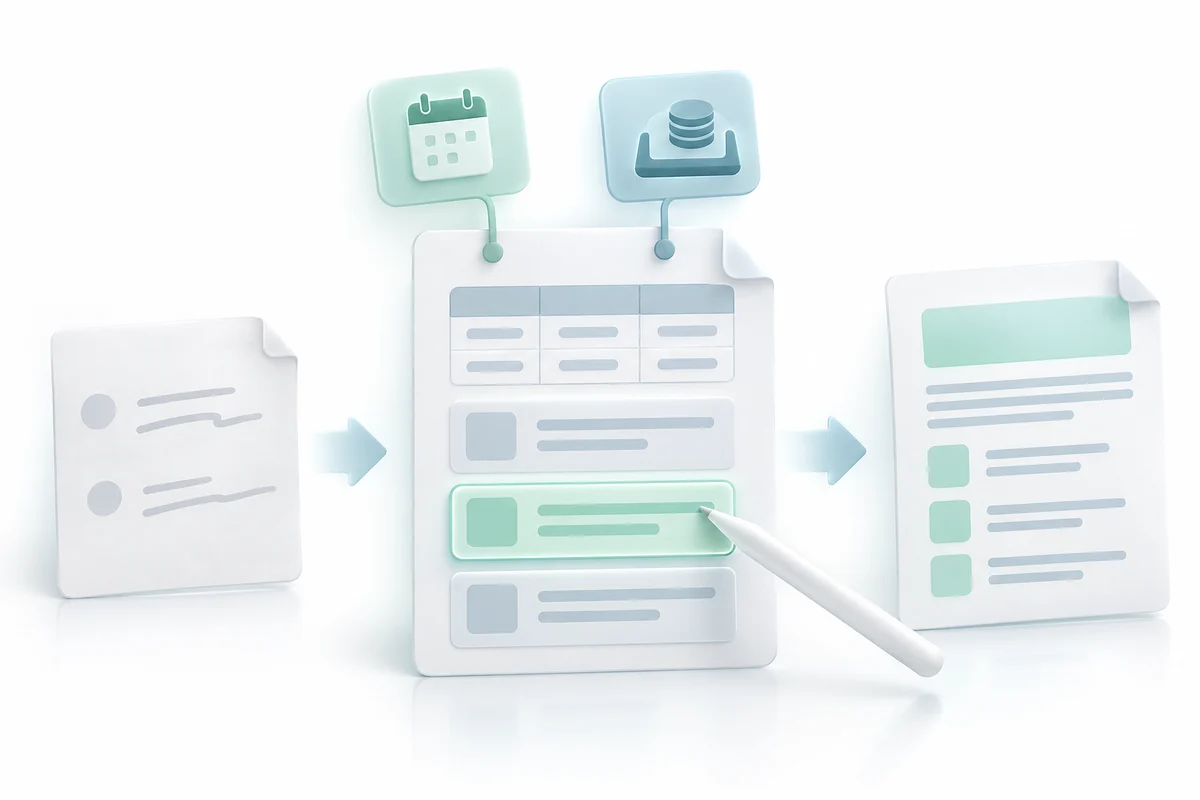
Continue the hypothetical article edit. The requester specifies general readers, retention of primary-source conditions, and no goal of reducing length for its own sake. The AI places an existing section alongside an easier-to-read revision. Before rewriting the whole article, the person can select an acceptable kind of simplification.
The feedback becomes specific: “Keep the measurement conditions. Shorten the product list. Explain what changes in someone's work before giving the conclusion.” The AI revises that section while retaining sourced facts and interpretation derived from comparison. Inspect both whether the requested changes appeared and whether explanations selected for retention survived.
An outline alone cannot establish the depth of the finished article. Once the structure works, expand the text and read the connections between sections. Keeping the revision unit small does not mean reducing the explanation required for completion. It means making the retained and changed material inspectable.
This exchange establishes order, density, and priorities. Capabilities and research numbers still need source checks even when the prose becomes convincing. Fit and factual verification can overlap, but passing one does not complete the other.
Prototypes also create assumptions and review costs
A concrete first version may focus attention on repairing that version rather than considering another structure. If explanatory order remains open, compare an example-first outline with a comparison-first outline instead of three paraphrases of one structure. State which difference the alternatives help select. This is a proposed technique, not a measured optimal number of options.
An intermediate artifact can also be too small. Headings alone may not reveal jargon, and one screen may not reveal connected operations. Add the text or behavior needed to make the decision possible. Rebuilding everything on each turn increases reading and comparison work.
To evaluate prototypes, inspect review time, repeated repairs, and unrequested changes alongside final quality. Compare with an existing template or one generation where those suffice, and ask whether burden falls at equivalent quality. Producing more options is not itself evidence of better collaboration.
Consolidate scattered conditions into the current brief
LLMs Get Lost In Multi-Turn Conversation compared six generation tasks with requirements supplied at once or over multiple turns. It analyzed more than 200,000 simulated conversations and reported an average 39% performance decrease in the latter setting, including reliance on early assumptions. This compares ways of supplying conditions; it is not a uniform length-dependent penalty for every revision dialogue.
After agreeing on an article structure, consolidate its readers, question, retained examples, and fixed conditions into a current brief. Record which requirement wins where earlier instructions conflict. Have a person inspect the summary rather than assuming the AI preserved every decision.
Keep the previous version and compare the requested area and material that depends on it. If the same feedback is repeatedly missed, do not merely add turns. Narrow the change or restart with consolidated agreed conditions. These are practical proposals, not guarantees that summarization eliminates failure.
Check completion beyond the feeling of a good conversation
An article is finished when it answers the reader's question, retains necessary comparisons and evidence, and allows numerical conditions to be checked against sources. For code, test agreed behavior and inspect changes and exceptions. For images, assess the chosen composition and purpose and verify usage conditions. Similar collaboration steps still require different final checks.
Anthropic's engineering guidance discusses intermediate gates and evaluation with revision, while recommending simplicity when it suffices. Reconsider the method when edits no longer change the decision or review cost keeps increasing. Iteration limits and completion criteria belong in the delegation design.
Stopping at “I like it” can preserve plausible errors. Repeating an undefined “make it better” after the checks pass can also erase the purpose of revision. Name the remaining deficiency, and stop when it is resolved.
Start where a person can judge, even without a complete preference
The research supports different uses of questions, intermediate results, tests, and revision under different conditions. It does not establish a universal collaboration method or the general superiority of prototypes. My recommendation follows those distinctions: move the work forward in a form that enables the person's next decision.
A perfect initial instruction is not required. State known conditions, inspect a small but sufficient artifact, and return reasons to retain material along with specific changes. Carry those choices into the next version and combine fit with evidence-based checks. AI collaboration should let people build and verify the work they want, rather than simply lengthen the conversation.